Camino de Santiago · Trails · Heritage
A stone waymarker
with a memory of its own.
A granite marker that also attends to whoever arrives: it runs on sunlight, speaks several languages and records every visitor who passes. The first one is proposed for kilometre zero of the English Way, in Ferrol.
Project under development for the 2027 Holy Year.
Open to councils, trusts, foundations and investors.
For the council that installs it: real footfall on the English Way for the first time —how many set out, when and in which language—, a channel of its own for events, heritage and local trade, and every pilgrim’s photograph carrying the city’s name around the world.
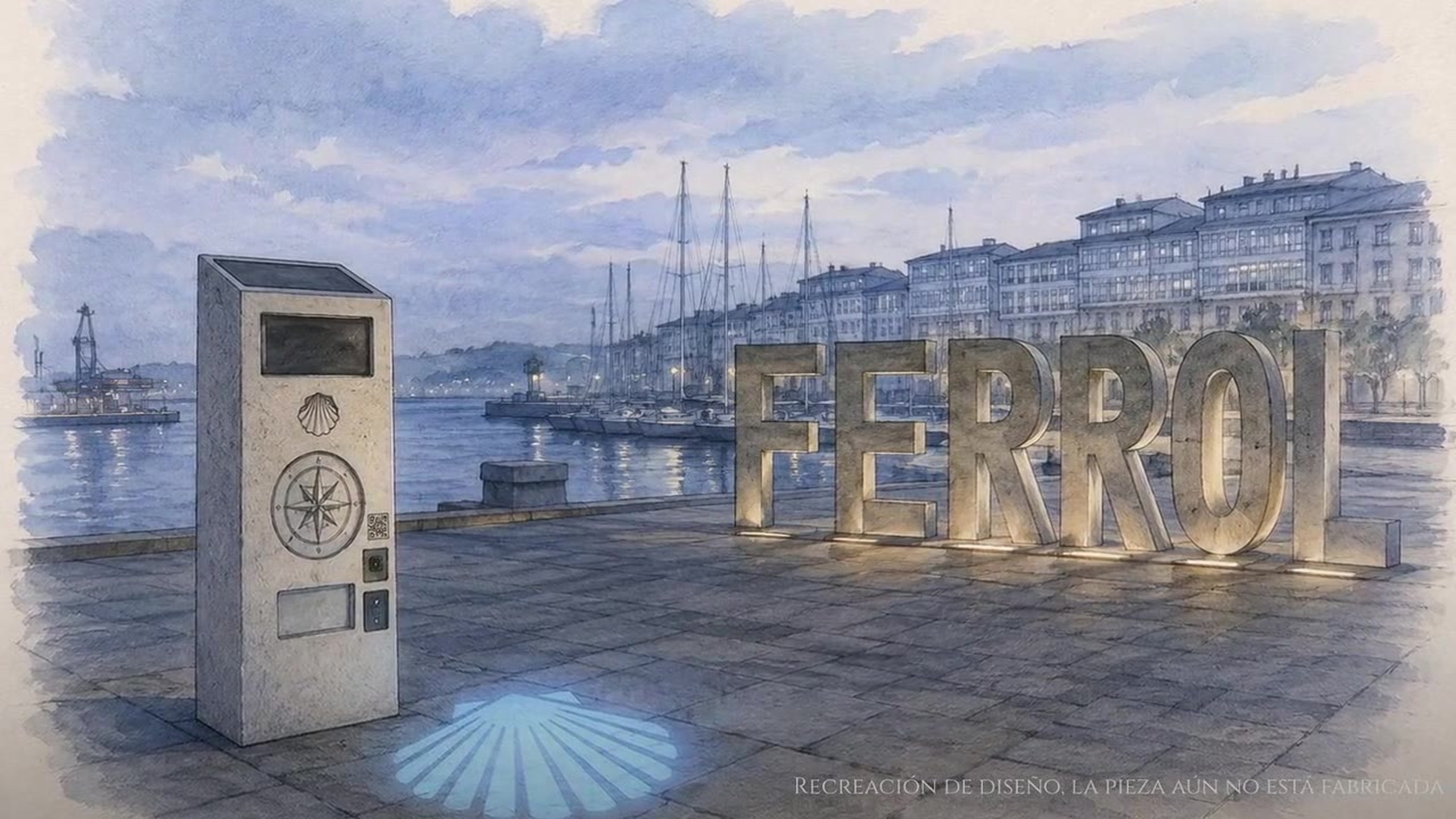
Design mock-up. The piece has not been manufactured yet.
This is how the countdown will look
on the Ferrol monolith's display.
The video
Before Santiago, Ferrol.
Thousands of pilgrims begin the English Way right here. Two minutes, from the Obradoiro square to Curuxeiras quay, and what that stone could do for those who arrive.
Design mock-up. The piece has not been manufactured yet.
Video transcript
One minute fifty-four, with no speech, over background music. It moves through the Obradoiro square in Santiago, a medieval bridge with pilgrims, the city of Ferrol, its harbour and its arsenal, a beach at sunset, and then several recreations of the granite waymarker and of the Conserxe screen. The captions on screen, in Spanish, are these:
- The Camino de Santiago. A journey that unites history, culture, nature and tradition.
- For centuries, thousands of pilgrims have walked its many routes towards a single destination: Santiago de Compostela.
- But to reach Santiago… you first have to begin the Camino.
- Ferrol. A city shaped by the sea, by history and by naval tradition.
- In the north of Galicia, Ferrol combines heritage, culture and nature in a setting all its own.
- For centuries its harbour has been a gateway to and from the Atlantic.
- Ferrol is the starting point of one of the routes to Santiago de Compostela: the English Way.
- Someone to help pilgrims begin their journey from our city.
- Something recognisable, within everyone’s reach.
- The stages of the route, one after another: Ferrol, Neda, Betanzos, Sigüeiro and Santiago de Compostela.
Near the end, a map shows the route drawing itself from Curuxeiras quay to Neda. It closes on black with a haiku in Galician — “Pedra no peirao, garda os pasos de quen vai cara a Santiago” —, the greeting “Bo Camiño” and the address www.totemkm0.es. The images of the waymarker are design mock-ups: the piece has not been manufactured yet.
The idea
Let the stone on the path be the one that welcomes you.
Every year thousands of people walk past a stone marker that only tells them how far Santiago is. The idea is simple: let that same stone also greet you in your own language, tell you about the stage ahead and record that you passed through.
On the outside it remains what it always was: granite cut by a stonemason. Inside it carries a solar panel, an e-ink display and an assistant that answers. Nothing to download, nothing to plug in.
That the pilgrim arrives in a new town and finds, in the very stone of the path, someone to welcome them. Enrique de Andrés Herrero · founder
The object
What is inside.
Traditional stonemasonry
Cut by a stonemason, designed to last generations outdoors by the sea.
Solar power
No trenching or mains connection required at suitable sites.
Multilingual assistant
It answers in the language of whoever asks, adding languages to suit each site.
Stamp of the place
A stamp unique to the place, within reach from a wheelchair, with a braille guide above it.
Specifications
- Material
- Galician granite, cut by a stonemason
- Power
- Photovoltaic. No mains connection
- Display
- E-ink, readable in full sunlight
- Contact
- NFC and QR. No app required
- Reach height
- 1,040 mm panel · 1,100 mm braille
- Languages
- GL · ES · EN · FR · DE · PT · IT, extendable
- Sound
- No beeps, no announcements. It answers only when asked
- Protection
- Utility model application, Spanish Patent Office
Design figures. The piece has not been manufactured yet.

Photograph by the founder.
Accessibility
Universal contact
A Camino without barriers.
A waymarker that makes no noise.
The Camino belongs to everyone, and the technology bends to ergonomics. Everything you need to touch sits on the right-hand side, at hand height.
The braille guide runs at 1,100 mm. Just below it, at 1,040 mm, wheelchair height, sit the QR code and the NFC panel: simply hold your phone close, with nothing to install.
The stone calls out to no one: no beeps, no automatic announcements, no public address. It has a speaker, but it only talks when someone asks, at conversation volume. And if you prefer silence, the same answer arrives in writing on your phone.
Design dimensions. The piece has not been manufactured yet.
Installing it
No building work, no bills, no staff.
Three reasons a council or a trust can consider one without opening a construction file.
No building work
It runs on sunlight. At suitable sites there is no need for trenching or a mains connection.
No bills
It draws nothing from the grid. The e-ink display only uses power when what it shows changes.
No staff
Granite outdoors and sealed electronics. Nobody needs to tend to it each day.
The technology does not depend on the Camino. The same piece works for a heritage trail, a natural park, a historic quarter or a seafront promenade, using the stone and the emblem of each place. The Utility Model pending at the Spanish Patent Office () protects the technology, not one particular destination.
About the MPICThe first one
Ferrol, kilometre zero of the English Way.
Curuxeiras quay is where English pilgrims came ashore to begin walking to Santiago. That is where the first piece is proposed, ahead of the 2027 Holy Year.
Location
Curuxeiras quay, at the exact starting point of the route.
Timing
2027 Holy Year. The English Way is drawing particular momentum ahead of it.
What it leaves behind
Every visitor who passes through becomes part of the city's record, and every photograph beside the waymarker travels on its own.
Cartography © OpenStreetMap contributors.
Forty-five seconds, no speech. Design mock-up. The piece has not been manufactured yet.
Video transcript
Forty-five seconds with no speech, over background music. It shows the granite waymarker on the Ferrol quayside, by night and by day, close-ups of the scallop shell, the code and the braille strip, and the Conserxe screen answering on a phone. The captions, in Spanish, are these:
- The English Way begins at the Atlantic. Its kilometre zero is in Ferrol.
- A granite marker with a memory of its own.
- It counts who passes by. For the first time.
- I am the Conserxe of Kilometre 0, and I answer in several languages.
- Ask me about Ferrol.
- Ask me what to see before you set off.
- Hold up your phone. No app, no sign-up.
- The first one, on the Curuxeiras quayside.
It closes with the Galician greeting “Bo Camiño”, the address totemkm0.es and a note that this is a design mock-up.
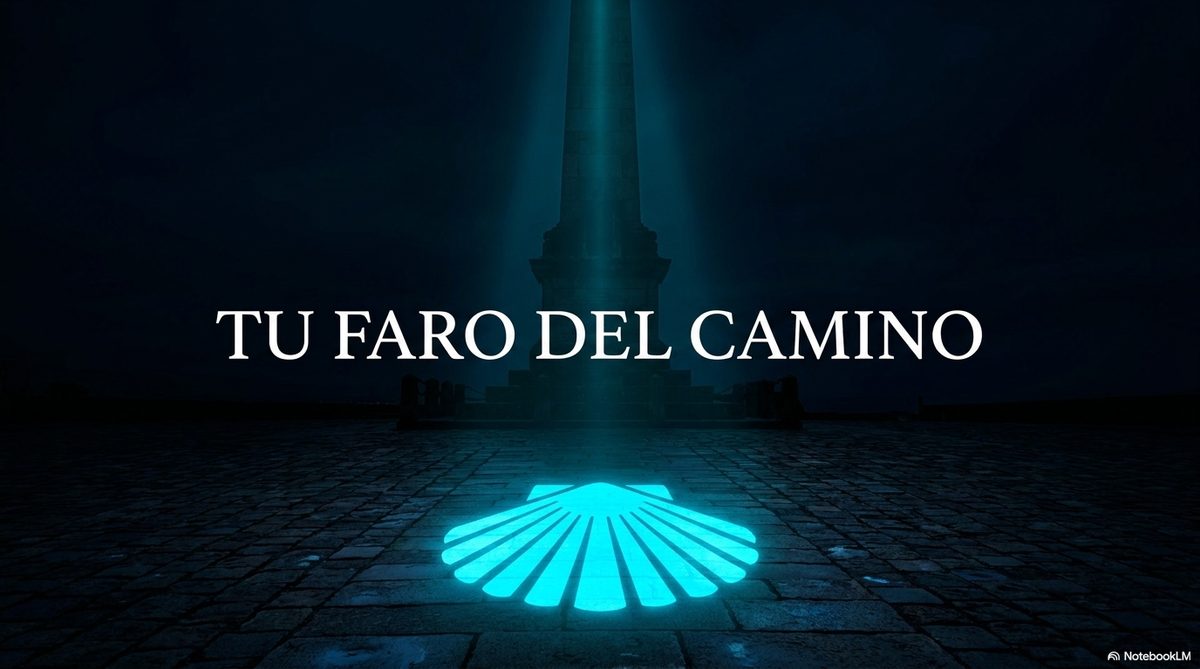
Design mock-up. The piece has not been manufactured yet.
Project status
Where it stands today.
Utility model application pending at the Spanish Patent and Trademark Office.
Already running
Conserxe.gal
This is the part that is already alive. The assistant that will give each monolith its voice: it knows the Camino and the town it stands in, and answers with figures for the specific stage, not generic ones. You can try it today.
Try ConserxeIt also answers in French, German, Portuguese and Italian.
Contact
Get in touch.
Councils, trusts, foundations, companies or press. If you want one on your route, or you want to join the project, tell us.
We use your details only to reply to you. We do not pass them to third parties or send advertising.